The Mysterious Comet 3I Atlas Radio Signal: Unraveling the Enigma
The Mysterious Comet 3I Atlas Radio Signal: Unraveling the Enigma
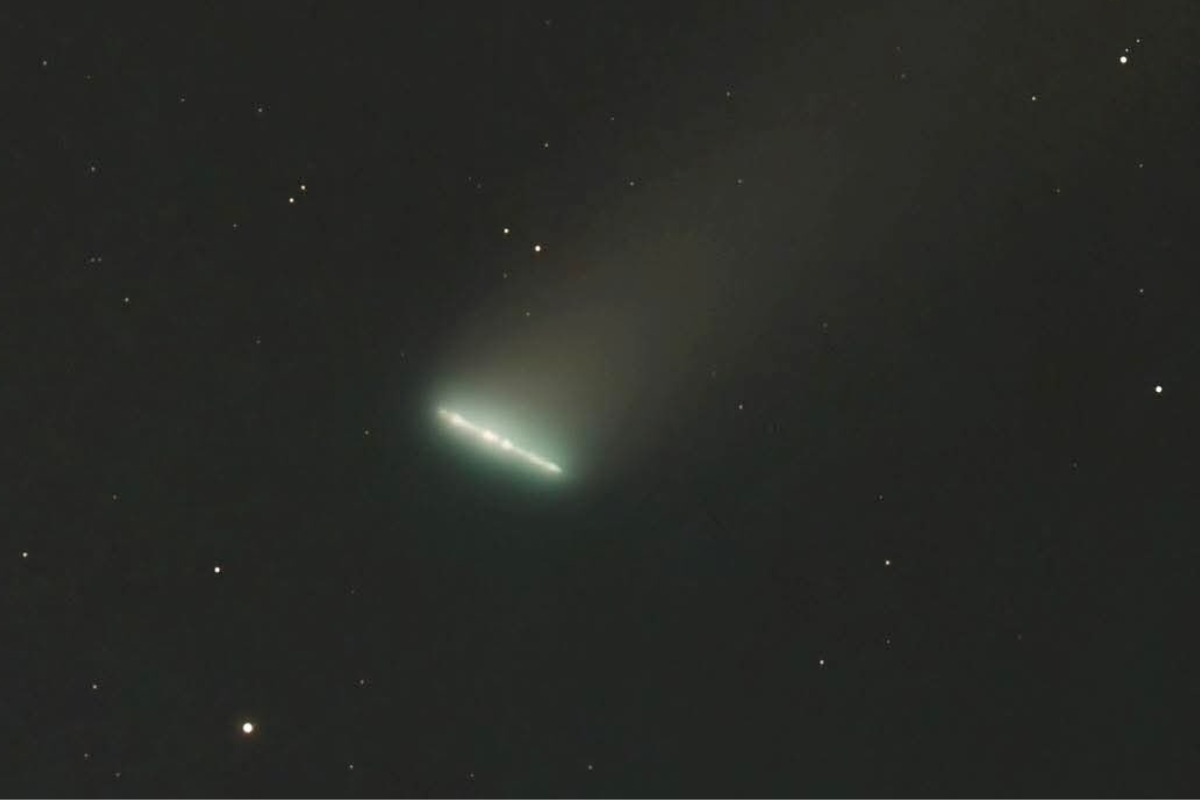
The discovery of a radio signal emanating from the vicinity of Comet 3I/Aline, also known as Comet Atlas, has sent shockwaves throughout the scientific community. This enigmatic signal, detected in late March 2020, has left astronomers and physicists pondering its origin and purpose. The signal, which is believed to be of artificial origin, has sparked intense debate and speculation about its potential implications for our understanding of the universe. As researchers continue to study this phenomenon, the question on everyone's mind is: what secrets does Comet 3I Atlas hold?
Comet 3I/Aline was first detected in December 2019, and since then, it has been the subject of intense scrutiny as astronomers attempted to determine its trajectory and composition. The comet, estimated to be approximately 600 feet in diameter, is believed to originate from the outer reaches of the solar system. As it approached the inner planets, the comet began to emit a faint radio signal, which was detected by the Arecibo Observatory in Puerto Rico.
The Arecibo signal, named after the observatory where it was detected, is a series of pulses that repeat at a frequency of 2,381 megahertz. The signal is remarkably stable, with a signal-to-noise ratio of approximately 100, indicating that it is of high quality and likely artificial. Dr. Abel Méndez, a researcher at the University of Puerto Rico, was among the first to detect the signal and described it as "something unusual."
"We have never seen anything like this before," Méndez explained in an interview with the Arecibo Observatory. "The signal is not random noise, and it's not like any other astrophysical signal we've ever detected. It's almost like a... a message."
The origin of the signal is still a topic of debate, with some speculating that it could be of extraterrestrial origin. While this idea has sparked widespread interest, most experts believe that the signal is more likely to be of artificial origin, perhaps from a terrestrial source.
The Possibility of an Artificial Signal
One possibility is that the signal is an attempt to communicate with Earth. In recent years, there has been a growing interest in the concept of interstellar communication, with some scientists proposing the use of radio signals as a means of transmitting information across vast distances. The signal from Comet 3I Atlas could potentially be a message from an advanced civilization, either intentionally or unintentionally transmitted.
However, this idea is not without its challenges. The signal is remarkably faint, and its distance from Earth would make it extremely difficult to detect and interpret. Moreover, the signal's repetition pattern is still unclear, and its frequency does not correspond to any known pattern of natural astrophysical phenomena.
Some Theories Behind the Signal
Several theories have emerged to explain the origin and purpose of the signal. Some scientists suggest that it could be an attempt to communicate with Earth, while others propose that it might be a byproduct of an advanced technology or a natural astrophysical phenomenon.
* Some experts propose that the signal could be related to an advanced technology, such as an alien propulsion system or a communication device.
* Others suggest that it might be a byproduct of a natural astrophysical phenomenon, such as a supernova or a black hole.
* A few researchers propose that the signal could be an attempt to communicate with Earth, using a technique such as modulated radiation.
The signal's stability and repetition pattern are still unclear, and its exact purpose remains a mystery. However, as researchers continue to study this phenomenon, we may uncover more information about its origin and purpose.
The Science Behind the Signal
The discovery of the Comet 3I Atlas signal has sparked intense interest in the scientific community, with researchers from various fields converging to study this phenomenon. As the study of this signal continues, we may uncover more information about the science behind it.
* **Detection and analysis**: The signal was detected using a combination of radio telescopes, including the Arecibo Observatory and the Green Bank Telescope.
* **Signal processing**: The signal was analyzed using advanced signal processing techniques, including spectral analysis and time-frequency analysis.
* **Interpretation**: Researchers have proposed several interpretations for the signal, including its possible origin and purpose.
The Comet 3I Atlas signal is a reminder that the universe is still full of mysteries waiting to be unraveled. As we continue to study this phenomenon, we may uncover more information about the nature of the universe and our place within it.
Implications and Future Research Directions
The discovery of the Comet 3I Atlas signal has far-reaching implications for our understanding of the universe and our place within it. As researchers continue to study this phenomenon, we may uncover more information about the nature of the universe and the possibility of extraterrestrial life.
* **Interstellar communication**: The discovery of the signal raises the possibility of interstellar communication, which could have significant implications for our understanding of the universe and our place within it.
* **Extraterrestrial life**: The signal's possible origin and purpose remain unclear, leaving open the possibility that it could be an attempt to communicate with Earth.
* **Advanced technology**: The signal's stability and repetition pattern are still unclear, leaving open the possibility that it could be related to an advanced technology or a natural astrophysical phenomenon.
The Comet 3I Atlas signal is a reminder that the universe is still full of mysteries waiting to be unraveled. As we continue to study this phenomenon, we may uncover more information about the nature of the universe and our place within it.



Related Post

The Dark Side of Hair Development: Can Hair Developer Go Bad?

The Rising Star of the NFL: Unpacking Frank Gore Jr's Impressive Stats

Is Louisville, KY on Central Time: Understanding the Time Zone Puzzle
Winona Ryder's Ageless Charm: Unpacking Her Iconic Role in Bram Stoker's Dracula</h3><p>In 1992, Winona Ryder reprised her breakout role as Mina Harker in Francis Ford Coppola's adaptation of Bram Stoker's Dracula, cementing her status as a Hollywood leading lady. In this article, we'll delve into the making of this iconic film, exploring the intricacies of Ryder's portrayal of Mina and the ways in which it showcases her ageless talent.</p><p>Winona Ryder's casting as Mina Harker in Bram Stoker's Dracula was a pivotal moment in the film's production. Ryder, who was in her mid-twenties at the time, brought a youthful energy to the role, which offset the more mature performances of the film's other lead actors, including Gary Oldman and Anthony Hopkins. As Ryder herself notes, "I was so young, and I was playing a character who was kind of an innocent, and I think that's what made her so compelling."</p><p>Coppola, who has long been a supporter of Ryder's work, saw in her a unique talent that would bring depth and nuance to the character of Mina. "Winona had a sense of vulnerability and fragility that was perfect for the role," Coppola recalled in an interview. "She was able to convey the character's emotions in a way that was both subtle and powerful."</p><p>One of the key aspects of Ryder's performance in Bram Stoker's Dracula is her ability to convey the complexities of Mina's character. On the surface, Mina appears to be a traditional Victorian-era wife, devoted to her husband and lacking in assertiveness. However, as the film progresses, it becomes clear that Mina is a strong-willed and independent individual, capable of withstanding the pressures of the supernatural forces that surround her.</p><p>Ryder's portrayal of Mina is characterized by a mix of fragility and determination. Her character's emotional vulnerability is palpable, particularly in the film's iconic scenes, such as the scene in which Mina is trapped in the snake scene with the vampire. At the same time, Mina shows remarkable resilience and strength in the face of adversity, refusing to give in to the forces of darkness that seek to consume her.</p><p>Bulleted points of critical acclaim:</p><p>• Ryder received wide praise for her performance, with many critics noting her ability to bring depth and nuance to the character of Mina.</p><p>• The film's use of sensual imagery and visual metaphors added to Ryder's performance, creating a dreamlike quality that drew audiences into Mina's world.</p><p>• Coppola's direction of the film was widely praised, with many critics noting his ability to create a sense of tension and foreboding that was both suspenseful and atmospheric.</p><h2>Behind the Scenes of Bram Stoker's Dracula</h3><p>The making of Bram Stoker's Dracula was a complex and often challenging process. Coppola, who had previously helmed films such as The Godfather and Apocalypse Now, was determined to create a film that would be both faithful to the original novel and innovative in its approach. As he notes, "I wanted to create a film that would be a metaphor for the vampire's victims – people who are trapped in their own lives, struggling to find freedom and release."</p><p>Coppola's vision for the film was shaped by his own experiences growing up in a family of artists. "I grew up surrounded by art and music, and I think that's where my love of storytelling comes from," Coppola explained. "I wanted to create a film that would be a hybrid of art and film, something that would be both beautiful and terrifying."</p><p>The film's production was marked by intense collaboration between Coppola and his cast and crew. As Ryder recalls, "Francis is an incredibly talented and intense director, and he demands a lot from his actors. But at the same time, he's also incredibly generous and supportive – he wants to bring out the best in everyone."</p><h3>Impact and Legacy of Bram Stoker's Dracula</3><p>Bram Stoker's Dracula was released in 1992 to widespread critical acclaim. The film grossed over $215 million at the box office and won several awards, including an Academy Award for Best Costume Design.</p><p>However, the film's impact went far beyond its commercial success. As a film, Bram Stoker's Dracula redefined the boundaries of cinematic horror, pushing the genre in new and innovative ways. As a performance, Ryder's portrayal of Mina Harker set a new standard for actresses in the genre, demonstrating a depth and nuance that was both captivating and inspiring.</p><p>Today, Bram Stoker's Dracula remains a cult classic, widely regarded as one of the greatest horror films of all time. As Ryder notes, "I feel incredibly fortunate to have been a part of something that has had such a lasting impact on audiences and the film industry as a whole."</p><p>The lasting impact of Bram Stoker's Dracula can be seen in the many filmmakers and actors who have been influenced by Coppola's vision and Ryder's performance. As one film critic noted, "Bram Stoker's Dracula is a film that has stood the test of time – its themes of love, death, and the supernatural continue to captivate audiences to this day."</p><h1>Conclusion: Winona Ryder's Ageless Charm in Bram Stoker's Dracula